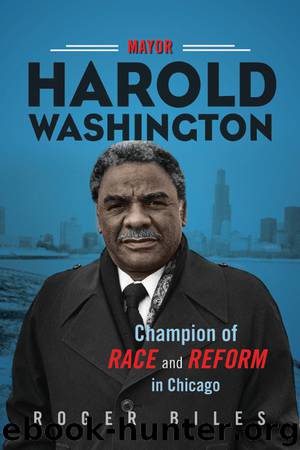
Mayor Harold Washington by Roger Biles
Author:Roger Biles
Language: eng
Format: epub
Publisher: University of Illinois Press
6
IN SEARCH OF A MANDATE
Washington prepared for his reelection campaign with the knowledge that he had yet to remove all doubts about the efficacy of his reform program. Because of the setbacks suffered during his first term in office—caused by the incessant guerrilla warfare in the city council that had frequently stymied his initiatives—the mayor had been able to enact very few of the changes he promised the electorate in 1983. A nightmare of contentiousness and obstructionism had obscured his lofty vision. He had continued to articulate progressive principles in a variety of forums and attained a national profile as an eloquent defender of the Democratic Party's core values, but critics charged and supporters reluctantly admitted that the number of substantive breakthroughs remained frustratingly small. In short, as Washington and his closest aides understood, his administration had not yet demonstrated to Chicagoans or to other elected officials in cities around the country that his design for rehabilitating ailing industrial cities would work. In order to validate a strategy of industrial retention, balanced growth, redistribution, and increased citizen access to local government, the Windy City's mayor would need to win another four-year term, establish a productive relationship with the city council, and wield power effectively to affirm that Chicago could indeed work together for the common good of its diverse population. Despite the encouraging political victories in the 1986 aldermanic elections, the most important work for Washington and his allies remained to be completed.
The final results of the special aldermanic elections came just one year before the 1987 mayoral election and a mere ten months prior to the Democratic primary. With the need to begin campaigning well in advance of the primary, a crucial activity that would consume much of the time and energy of Washington partisans inside and outside of city hall, the administration possessed only a few months to put the finishing touches on the mayor's first-term record. After an unceasing, three-year struggle against Vrdolyak, Burke, and their followers, the new city council majority relished the opportunity to set agendas and make policy but would enjoy only a limited time to complete unfinished business and perhaps launch a few new initiatives before the election. The mayor's allies looked forward to dislodging legislation bottled up in city council committees, approving mayoral appointments that had been sidetracked by hostile aldermen, and advancing progressive measures first enunciated by Washington in 1983 but left fallow during the ensuing Council Wars. His reform agenda blunted for so long by a ruthless and unyielding opposition, the mayor would be able at last to demonstrate the plausibility of his soaring reform rhetoric. Moreover, control of the city council would allow the administration to demonstrate that the lack of progress in some areas owed to the exertions of unscrupulous aldermen and not to its own lack of proficiency. Demonstrated mastery of city hall would show the voters how a competent local government could translate the mayor's plans into a reality that benefited all Chicagoans, regardless of social class, race, ethnicity, or gender.
Download
This site does not store any files on its server. We only index and link to content provided by other sites. Please contact the content providers to delete copyright contents if any and email us, we'll remove relevant links or contents immediately.
| Africa | Americas |
| Arctic & Antarctica | Asia |
| Australia & Oceania | Europe |
| Middle East | Russia |
| United States | World |
| Ancient Civilizations | Military |
| Historical Study & Educational Resources |
Cat's cradle by Kurt Vonnegut(15365)
Pimp by Iceberg Slim(14523)
4 3 2 1: A Novel by Paul Auster(12405)
Underground: A Human History of the Worlds Beneath Our Feet by Will Hunt(12101)
The Radium Girls by Kate Moore(12036)
Wiseguy by Nicholas Pileggi(5795)
The Fire Next Time by James Baldwin(5454)
Perfect Rhythm by Jae(5415)
American History Stories, Volume III (Yesterday's Classics) by Pratt Mara L(5312)
Paper Towns by Green John(5196)
Pale Blue Dot by Carl Sagan(5013)
A Higher Loyalty: Truth, Lies, and Leadership by James Comey(4967)
The Mayflower and the Pilgrims' New World by Nathaniel Philbrick(4509)
The Doomsday Machine by Daniel Ellsberg(4493)
Killers of the Flower Moon: The Osage Murders and the Birth of the FBI by David Grann(4451)
The Sympathizer by Viet Thanh Nguyen(4398)
Too Much and Not the Mood by Durga Chew-Bose(4353)
The Borden Murders by Sarah Miller(4330)
Sticky Fingers by Joe Hagan(4208)
